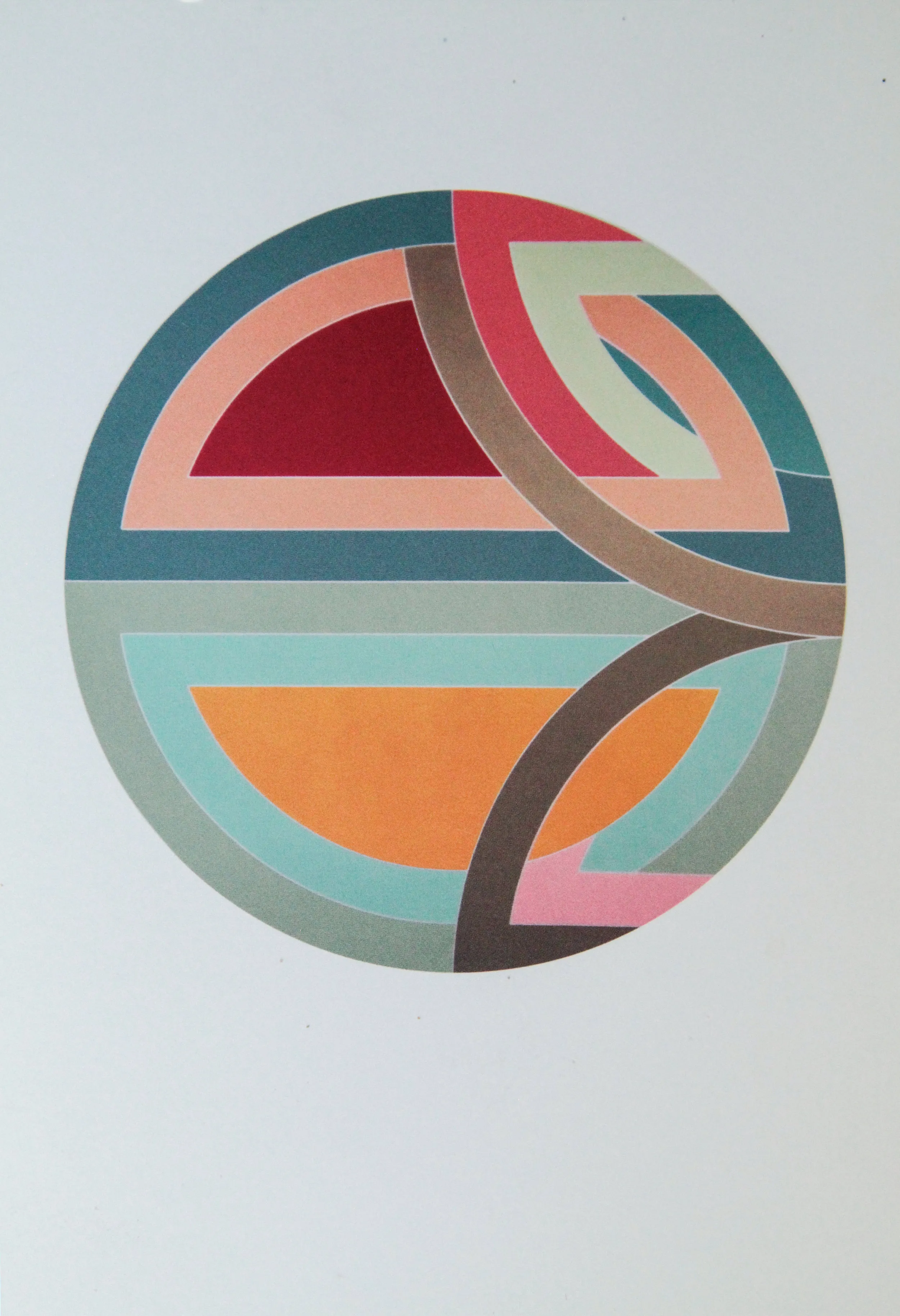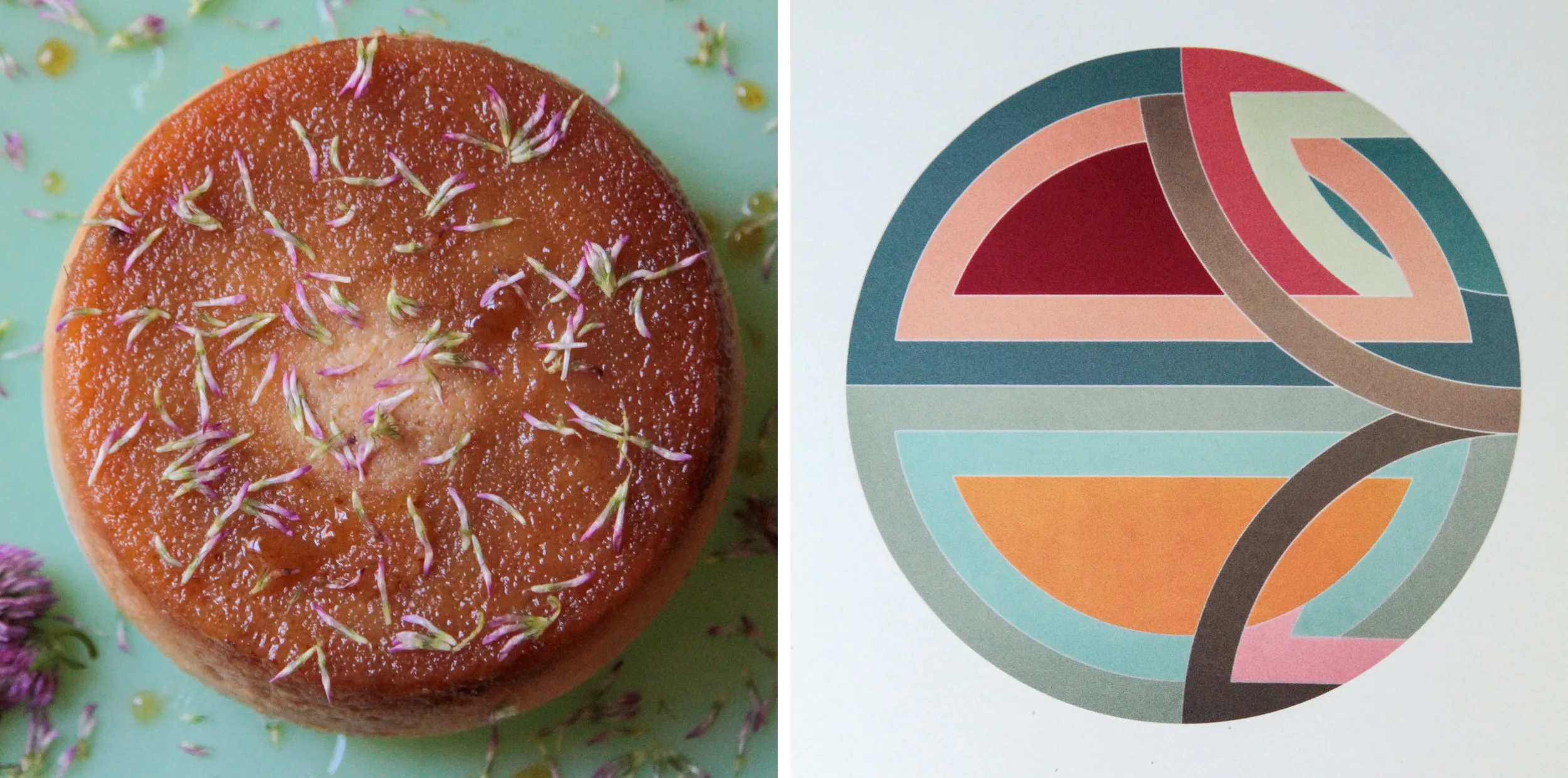
Frank Stella (b. 1936) first made a name for himself as a contender to Abstract Expressionism, reacting against expressive use of paint and favoring flatter compositions such as those of Barnett Neumann. He increasingly treated the painting as an object rather than a representation, thinking of painting as simple a flat piece of canvas with paint on it. This led to the Protractor Series (1967-1970), of which Sinjerli Variation I belongs: large, 10ft-wide meticulously crafted canvases in which he introduced curves. This pieces constitutes a tondo, the Renaissance term for larger round works in painting and sculpture, deriving from the Italian word “rotunda,” or round. The Sinjerli series was inspired by Stella’s travels in Southeast Asia and is named after an archaeological site of the ancient city Zincirli Höyük in Southeastern Turkey which was surrounded by a circular city wall. You can watch Stella discussing the Protractor Series here.
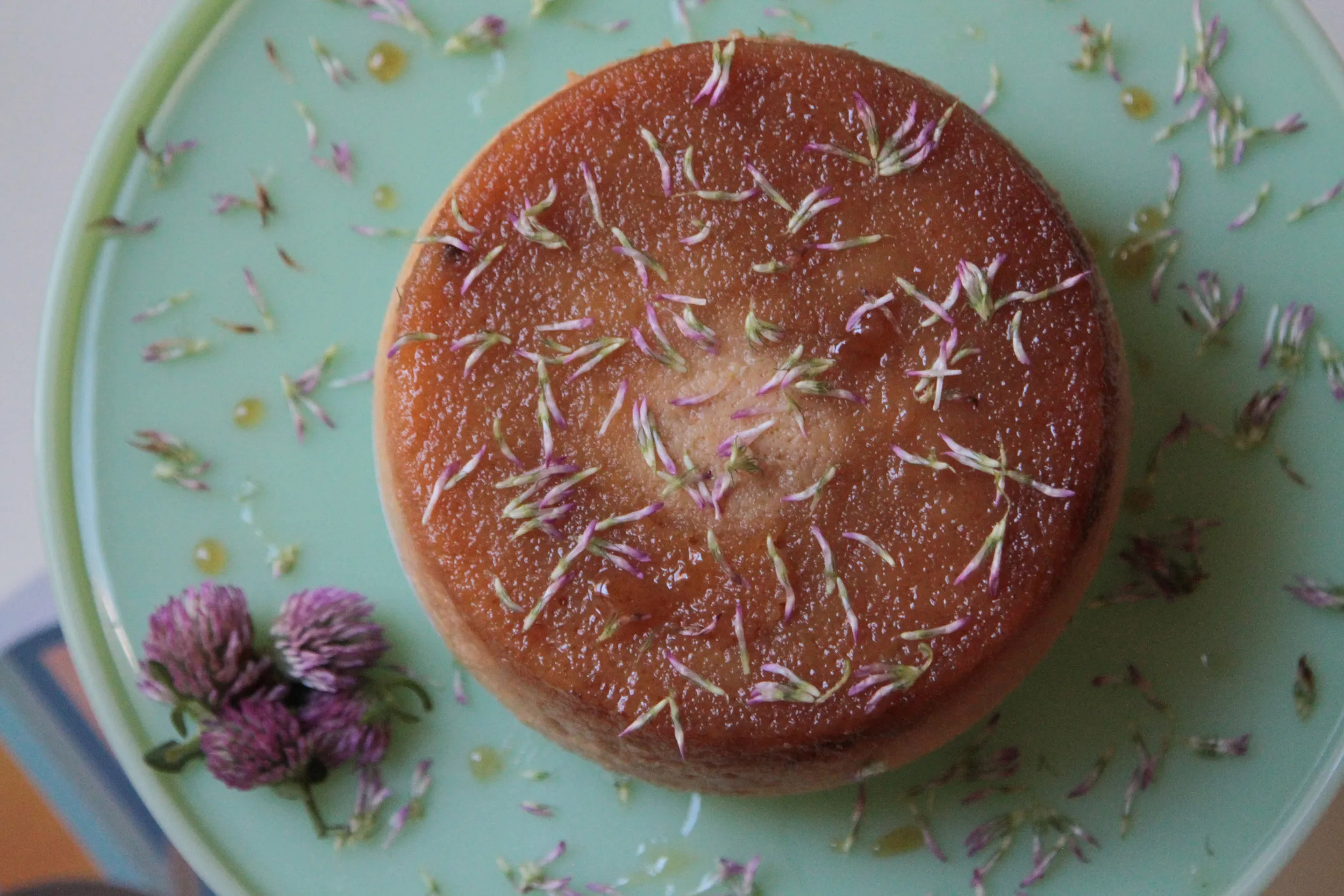
In celebrating the circle, I chose to make a recipe from Julia Child’s Mastering the Art of French Cooking which uses a charlotte mold. More so than a traditional cake’s proportions, desserts made in a cylindrical charlotte mold are taller and less wide, emphasizing the volume of the cylinder in a lovely way. Although the recipe calls for a 6-cup mold, I could only find an 8-cup mold without ordering from France, and it worked fine. I recommend placing the custard on a small plate the same size as the base before placing it on a serving stand—it makes it easier to extract from the mold, and makes up for the height difference if you’re using a larger-than-called-for mold. You could also increase the recipe proportionally by one-third; as this was my first attempt making this delicate custard I did not want to take that risk.
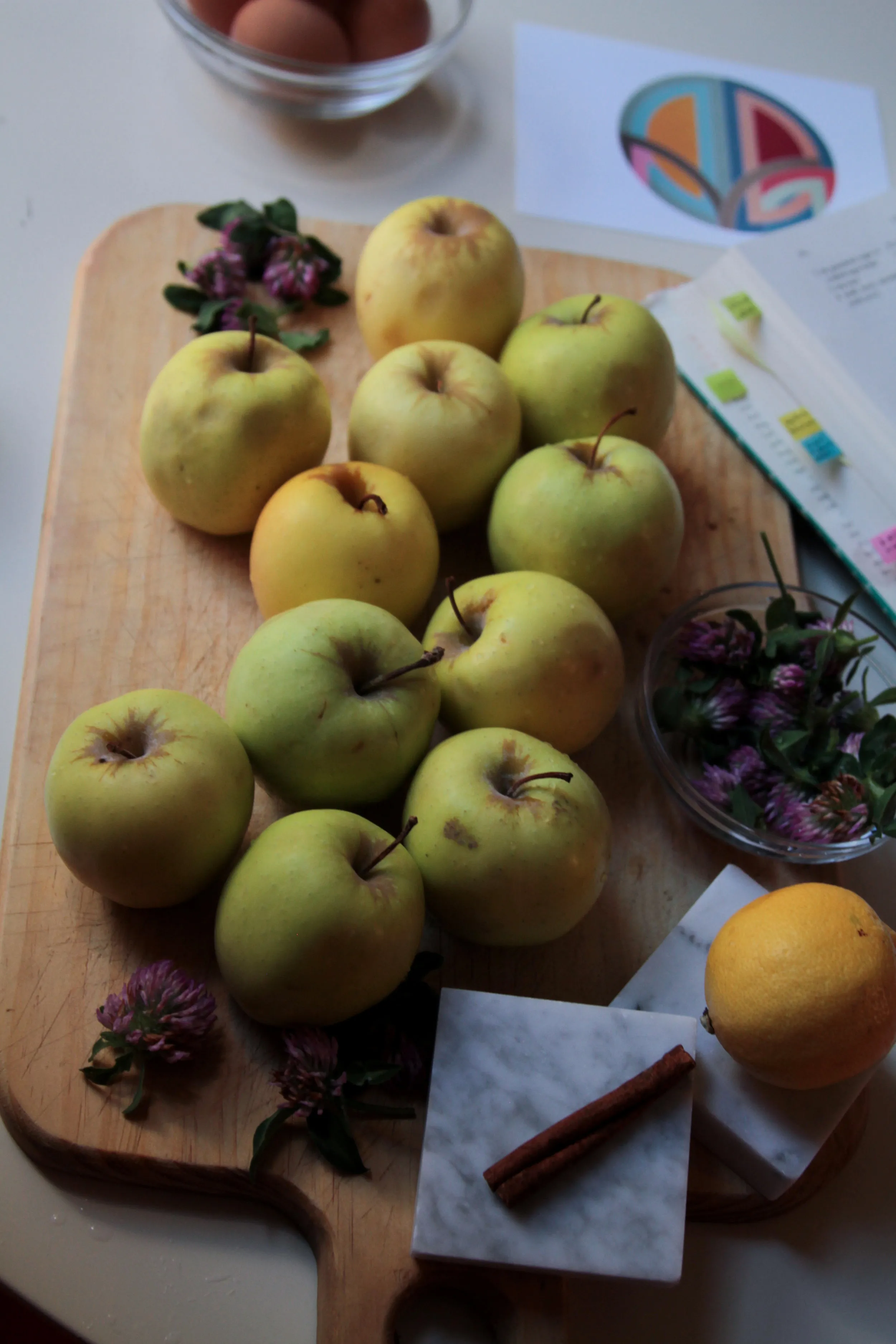
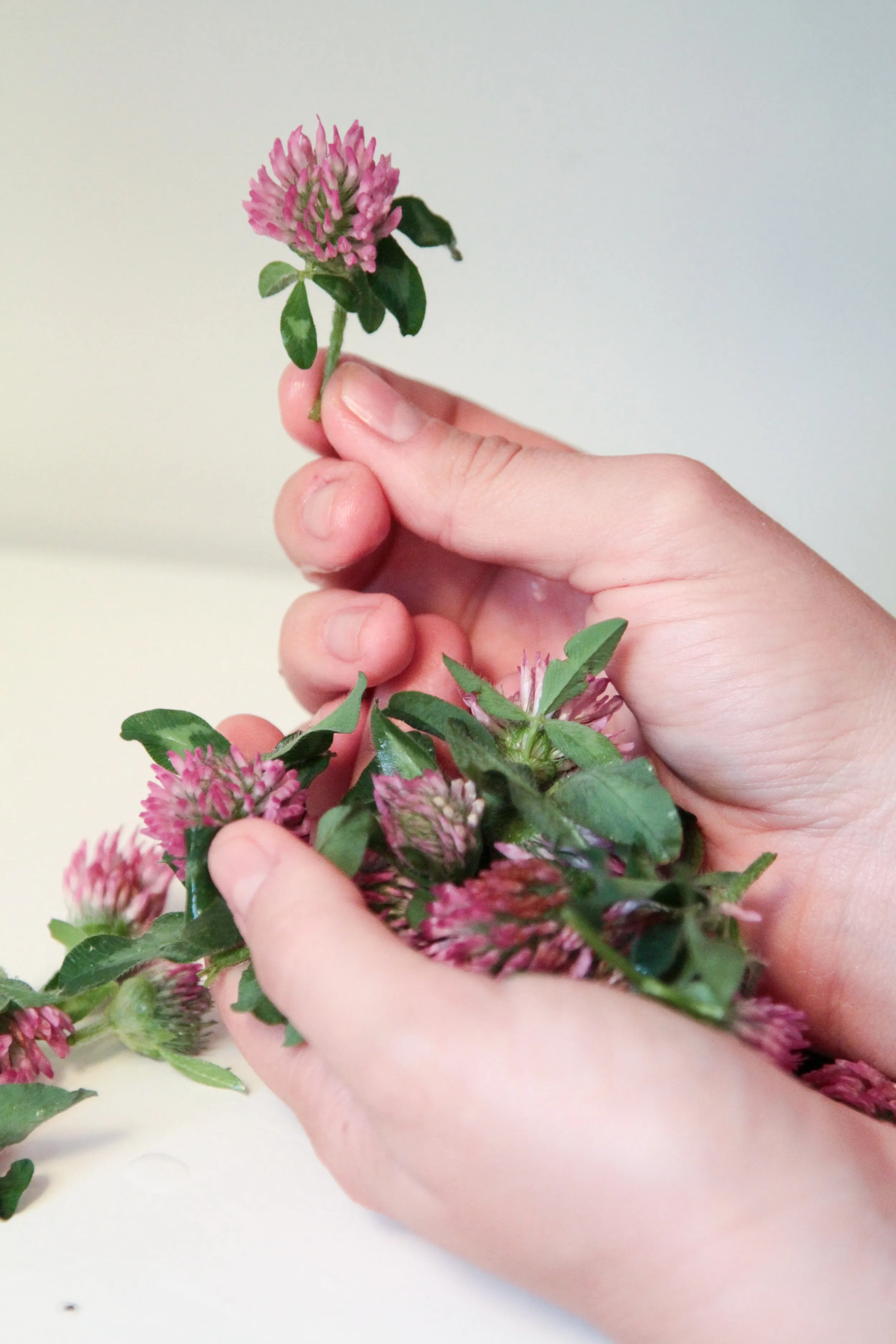
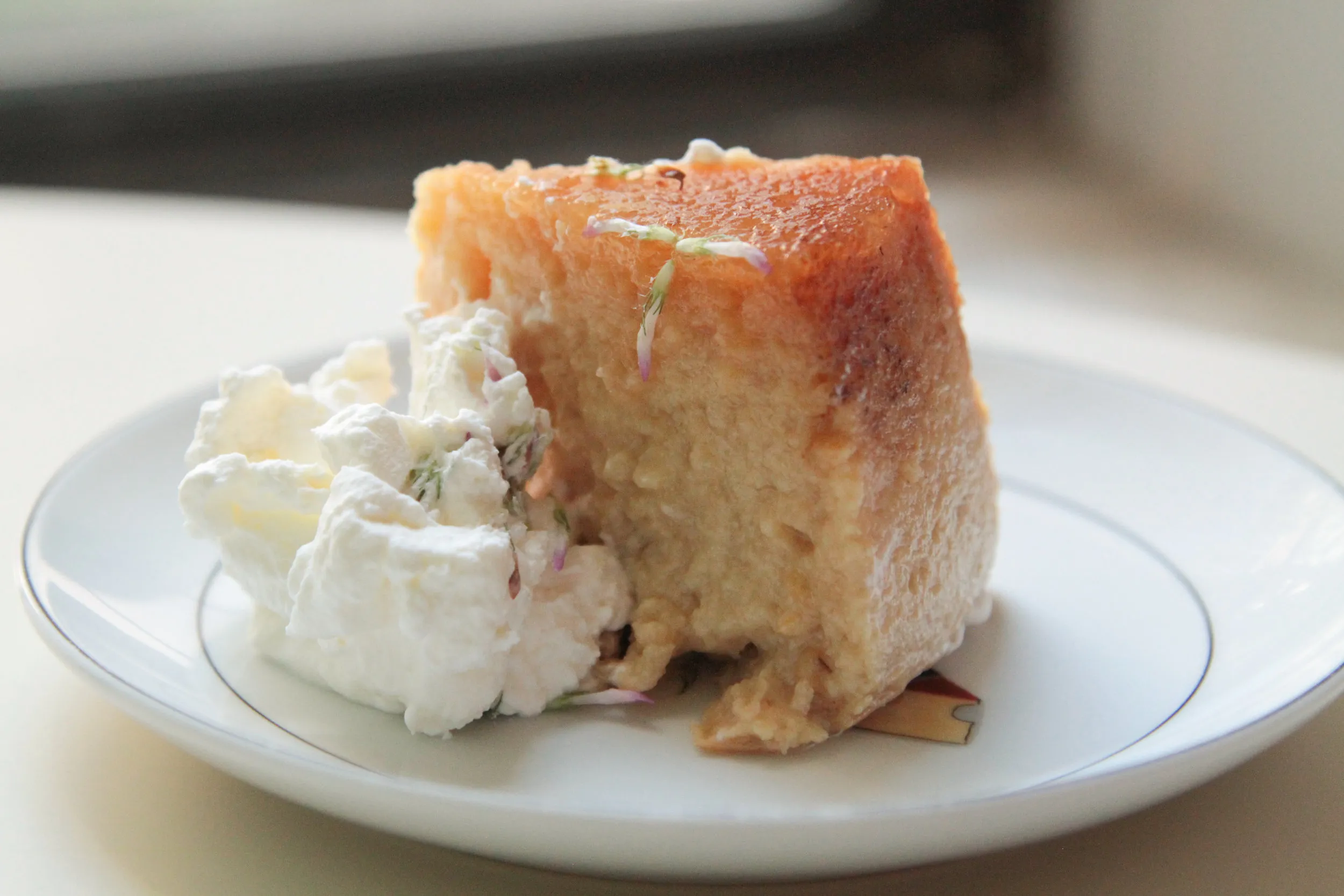
The only alteration I made was to add Red Clover petals sprinkled on top. These beauties were procured from the Windfall Farms stand at the Union Square Farmer’s Market; they have a variety of luscious edible flowers. The clover is mildly sweet and makes for a beautiful complement to the apple, lemon zest and caramel flavors. A nice perk to this dessert is that it satisfies those beginning-of-autumn cravings and yet is gluten-free.
Recipe from Mastering the Art of French Cooking, by Julia Child, p. 624
Ingredients
- 4 lbs. crisp cooking or eating apples
- a heavy-bottomed enameled pan (saucepan, casserole, or skillet) about 10 inches in diameter
- a wooden spoon
- 1/4 tsp cinnamon
- grated peel of 1 lemon
- 1/2 cup granulated sugar
- 1/4 cup rum, cognac, or excellent apple brandy
- 4 tablespoons of butter
- 4 eggs
- 1 egg white
- 6-cup, fireproof, cylindrical mold (“Charlotte mold”) lined with caramel*
- a lid or plate
- a deep saucepan or kettle
- boiling water
- a serving dish
- 4 tb rum, cognac, or apple brandy (optional)
- 2 cups lightly whipped cream flavored with powdered sugar and rum or brandy, or 2 cups creme anglaise
- fresh Red Clover flower petals, for serving (optional)
Process
Peel and core the apples (an apple spiraler is great for this! Mine was one of the first gifts my sweet now-husband ever gave me). Slice or dice them roughly into 1/8-inch pieces. You should have about 10 cups. Place them in the pan; cover and cook over very low heat for about 20 minutes, stirring occasionally, until tender.
Preheat the oven to 400 degrees.
Beat the cinnamon, lemon peel, and sugar into the apples. Do this by hand or with an immersion blender. Raise heat and boil, stirring, for 5 minutes or so, until the apples have reduced to a thick purée which will hold its shape on the spoon. You should have about 4 cups of applesauce. If you have more, set it aside to eat on its own!
Remove from heat and stir in the rum or brandy, then the butter. One by one, beat in the eggs, then the egg white.
Turn the apple mixture into the caramel-lined mold. Cover with lid or plate, and set in the saucepan or kettle. Pour boiling water around the outside of the mold to come up to the level of the apple mixture. Place in lower third of preheated oven. Check the oven heat to make sure the water stays almost simmering. Bake for 1 to 1.5 hours, until the custard begins to pull away from the sides, and everything on the top is set except for the very center.
To serve it warm, remove the mold from the saucepan it’s sitting in, and allow the dessert to cool for 20 minutes. Then reverse it on a serving dish. ( I ate it cold, but I think warm would be even better). To serve cold, chill it for 4 to 5 hours or overnight. Then run a knife around the edge of the dessert and reverse on a serving dish; in a few seconds to minutes it will dislodge itself from the mold.
Optional: Simmer the rum or brandy in the mold to dissolve any remaining caramel, and strain over the dessert. Surround the dessert with whipped cream or sauce. Top with plucked petals from Red Clover buds.