Long familiar with his dancers and painted scenes of movement, I got to know Degas more closely through the excellent 2011-2012 exhibit “Degas and the Nude” at the Museum of Fine Arts in Boston. The curators traced through his work a confusing tension between a dedication to portraying the female form that suggested an intimacy or admiration—and an over-heightening of what would have been considered repulsive at the time, trying almost too hard as a man insecurely disdaining of women might do, to expose women in awkward positions and angles as if this could compromise or challenge their self-assured beauty. Later in his life he was revealed to be anti-Semitic; given how one with a proclivity toward injustice and discrimination in the form of racism often extends his views of superiority to the realm of gender as well, the question of his sentiments toward women remains hazily unanswered. Sebastian Smee of the Boston Globe does consider the question more closely and eloquently in his article about the exhibit.
Degas did, however, produce prolific amounts of aesthetically masterful and significantly influential work. I personally appreciate having so many paintings of women “at work”—in positions of paid labor, often showing dancers backstage to emphasize the job-like nature of their work. Perhaps Degas focuses his lens on the artful life executed with a need for compensation, at the mercy of someone willing to pay for it, because Degas himself experienced a transition from being able to painting as a luxury (he was born into a moderately wealthy family) to having to paint for his livelihood once his brother’s debts bankrupted the family.
In addition to painting, Degas made sculptures, etchings, and was interested in photography in later life. For an artist who stubbornly insisted that an artist can have no personal life and the public should know nothing of the artist as a person, he is frequently noted in biographical accounts for his brusque personality and isolation over the course of his lifetime, which included the dissolution of his friendship Pierre-Auguste Renoir, photographed with Stéphane Mallarmé by Degas below in 1895. He maintained a close working relationship with Mary Cassatt, a painter, printmaker and feminist until their disagreement over the Dreyfus Affair.
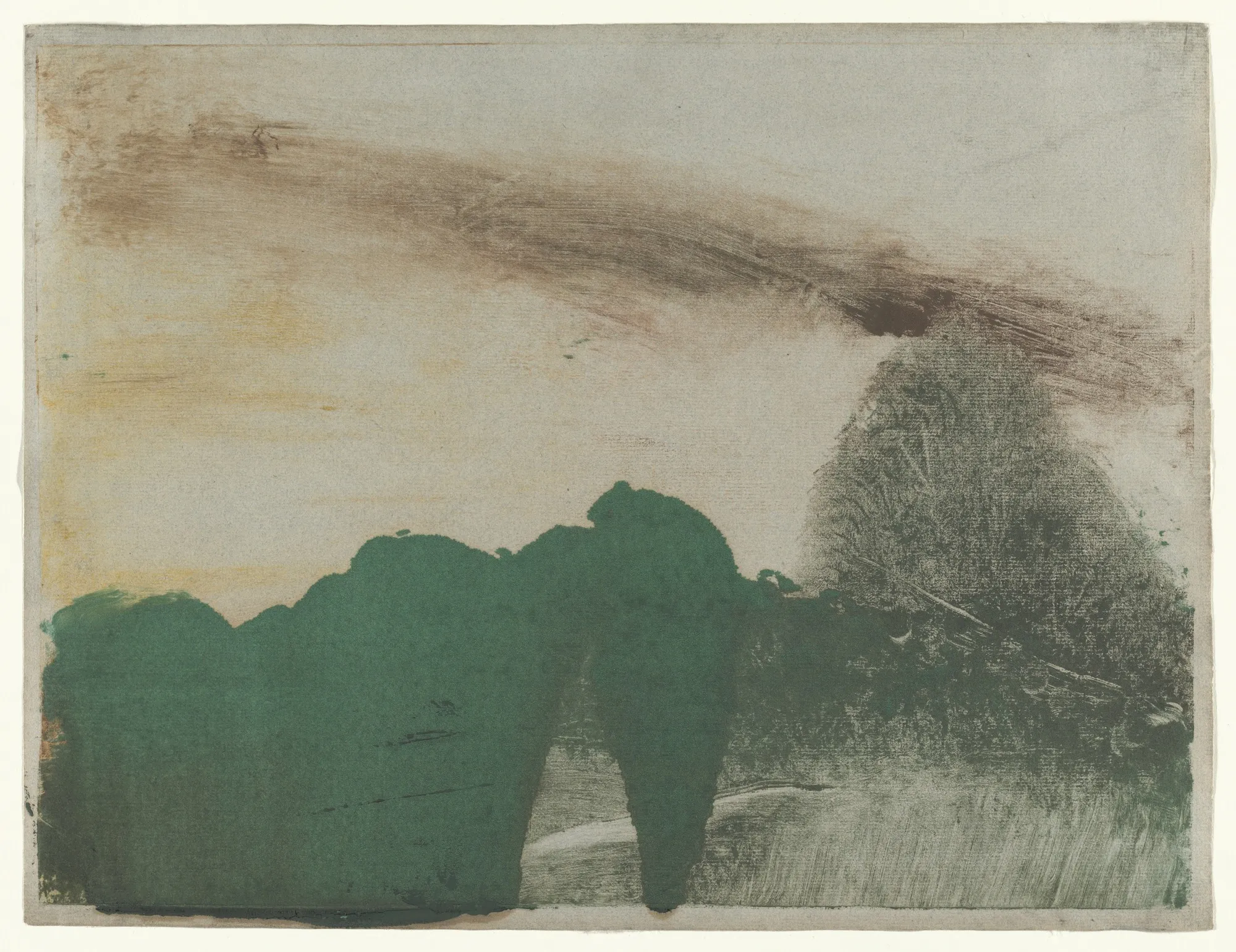
Degas was an eminent *peintres-graveurs—*the term refers to painters who made their own printed compositions rather than creating prints based on the reproduced work of others. The print chosen above is an extremely rare example of a Degas landscape; although he is considered one of the founders of Impressionism and helped developed much of the aesthetic of the movement, he rejected the label, considered himself a Realist, and deplored his peers for painting *en plein air, *preferring to paint indoors in his studio from memory and the use of live models. This monotype was inspired by a twenty-day trip he took through Burgundy. Forest in a Mountain, above, was completed circa 1890; it is abstract, psychologically poignant and stunning in its atmospheric ambiguity.
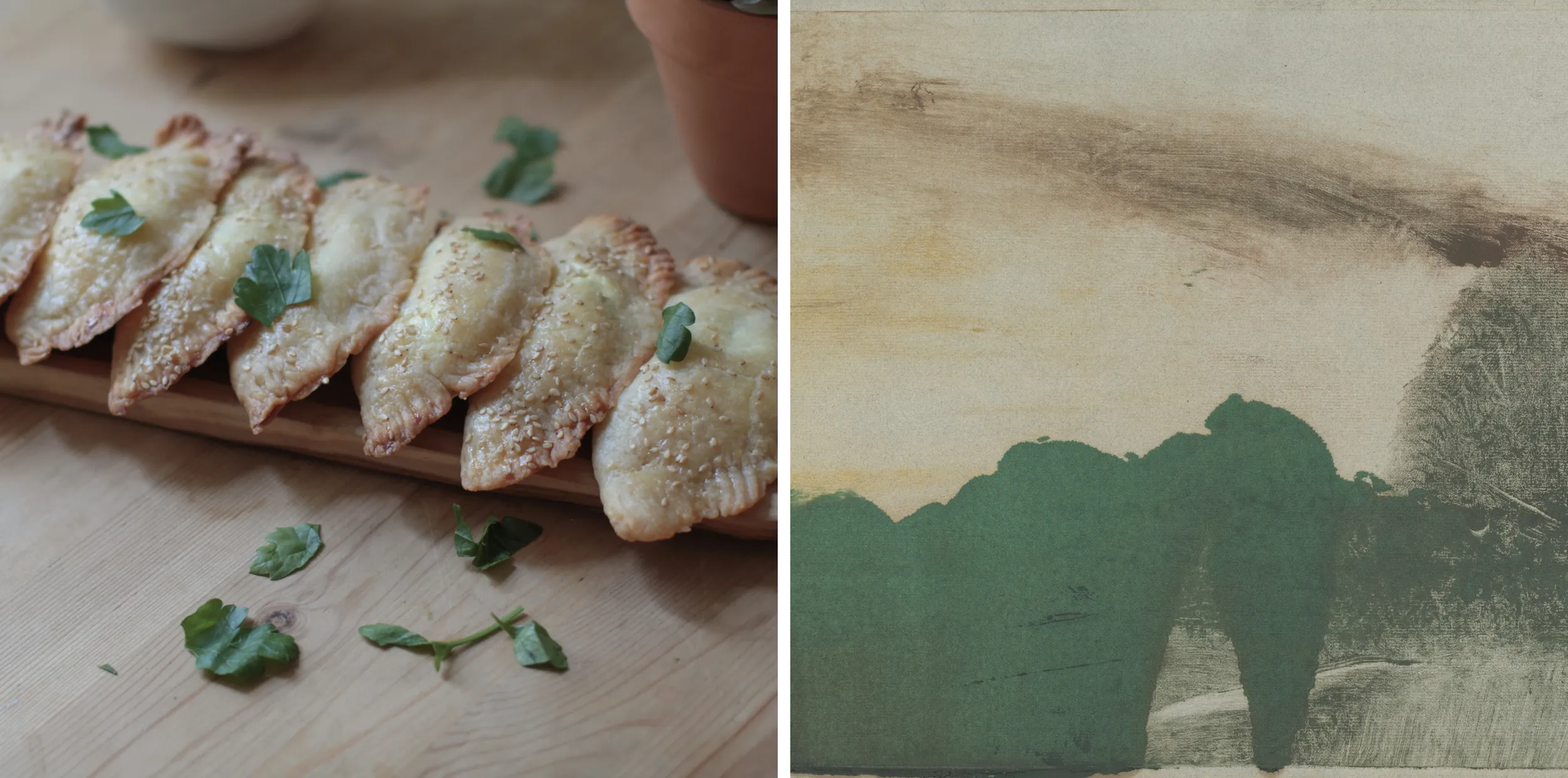
The golden, wheat-like sky and the rich greens of the earth are reminiscent of that most basic of sustenance provided through wheat and vegetation. For this pairing I have chosen to share the traditional, rural, homemade-dough version of Greek handheld cheese pies, a delicious food for a journey. I made these to take to a concert in Central Park, where with our friend Dimitra we sat on picnic blankets and listened to the New York Philharmonic perform outdoors. We shared these hand pies with a father and teen son sitting near us, who loved them. The rich, crumbly pastry dough is full of texture and flavor and moistened with yogurt; differing from and in my opinion better than the thin-sheeted phyllo more often used in savory pies. Along with a small filling of cheese and the inclusion of flavorful parsley and mint, these hand pies are certain to fill and delight.
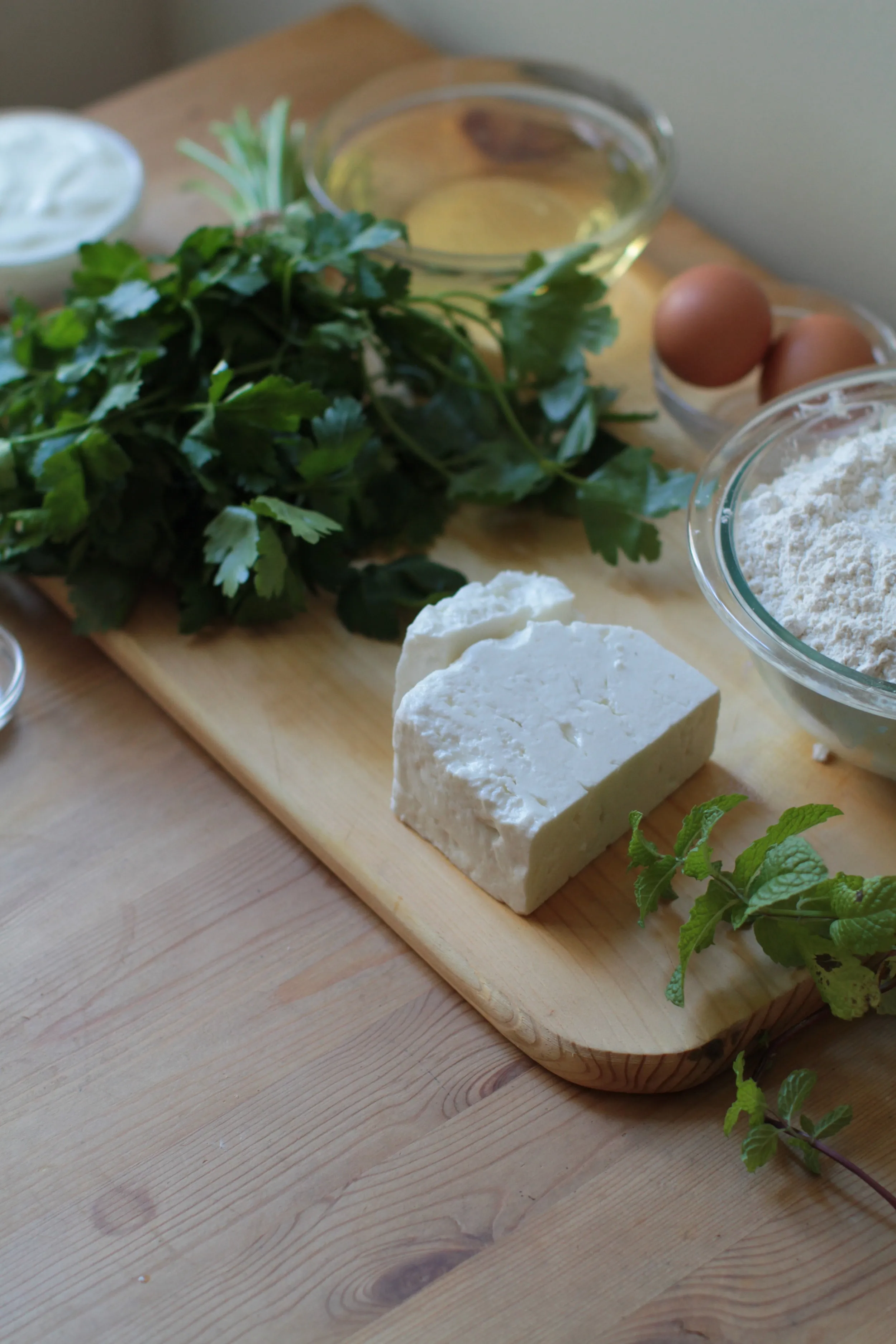
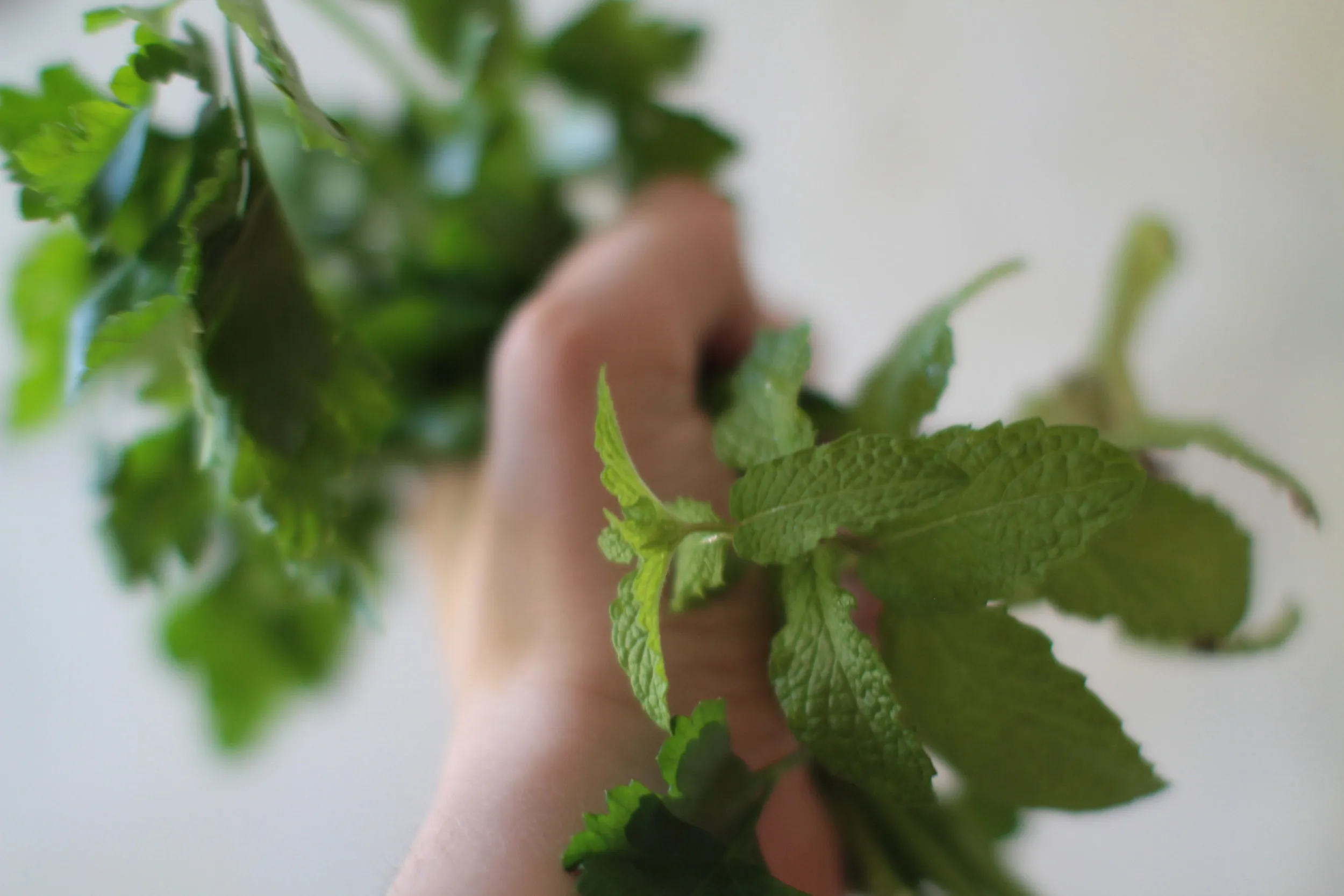
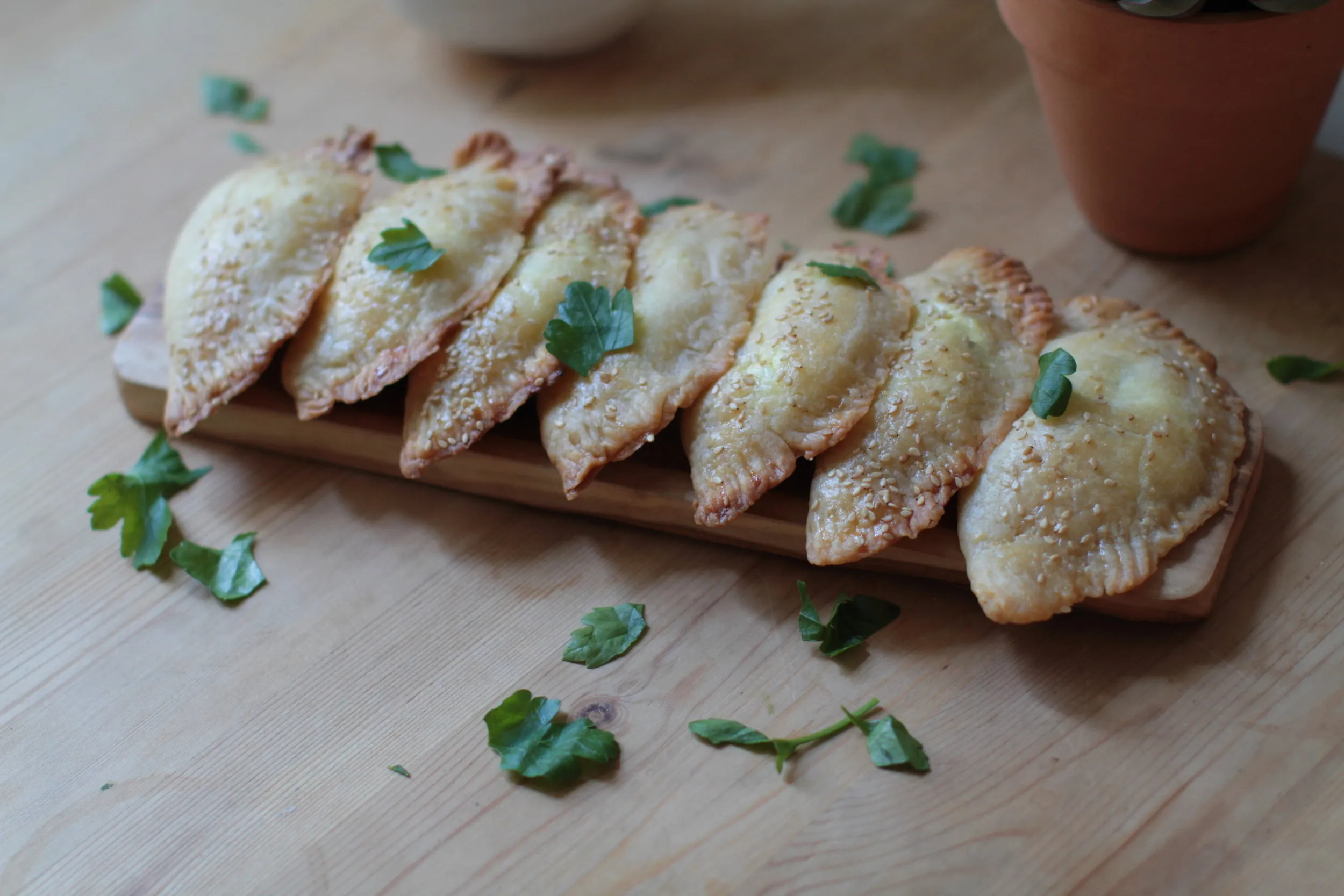
This recipe is adapted from Marilena’s Kitchen, a lovely site dedicated to sharing recipes & photography. Thank you for sharing, Marilena!
Ingredients
- ¼ cup warm water
- 2 tsp dry active yeast
- ½ tsp sugar
- 2 cups all-purpose flour
- ½ tsp salt
- ½ cup plain Greek yogurt (like Total 2%), room temperature
- ½ cup extra virgin olive oil
- 8 oz. Greek Feta cheese (like Dodonis), crumbled
- 1 large egg
- 2-3 tbsp chopped fresh parsley
- 2 tbsp chopped fresh mint
- 1 large egg, lightly beaten (for brushing on the top of the pies)
- sesame seeds (optional)
Process
- Measure ¼ cup of warm water in a measuring cup. Whisk the yeast and the sugar into the water and let stand until it bubbles, about 5 minutes.
- In a stand mixer equipped with a paddle, mix the flour with the salt. Pour in the water/yeast mixture, the Greek yogurt and the olive oil. Blend until the mixture forms a soft ball and the dough is elastic and easy to handle. If your dough seems dry, add some more warm water (1 tablespoon at a time). If it is too wet, add a bit more flour. Cover and let the dough rest for about an hour or until double in volume.
- After this resting time, punch the dough down to deflate and turn the dough out to a lightly floured surface. Divide it into 12 equal portions, about the size of a small walnut.
- Crumble the feta cheese with a fork and put it in a medium-sized bowl. Break the egg inside the bowl, add the chopped parsley and mint, and stir with a spoon until mixed.
- Preheat the oven to 375° F.
- Work with one piece of dough at a time, press it with the palm of your hand (or a small rolling pin, if you prefer) to make a roughly 3-inch disc. Fill each round with about a tablespoon of the filling, making sure not to spread it towards the edges of the dough or you will not be able to close it properly. Fold the dough over the filling and with a fork press down to seal and make a nice undulating edge. Place on a parchment paper-lined baking sheet. Repeat with the rest of the dough and filling.
- Brush the cheese pies lightly with the beaten egg, and sprinkle some sesame seeds on top (if using.) Place the baking sheet on the middle rack of the oven and bake for 20 to 25 minutes or until golden brown. Take them out of the oven and place on a wire rack to cool.
- Eat them warm or at room temperature. To store, cover lightly with aluminum foil and leave at room temperature for one or two days, although they will likely be eaten before then!