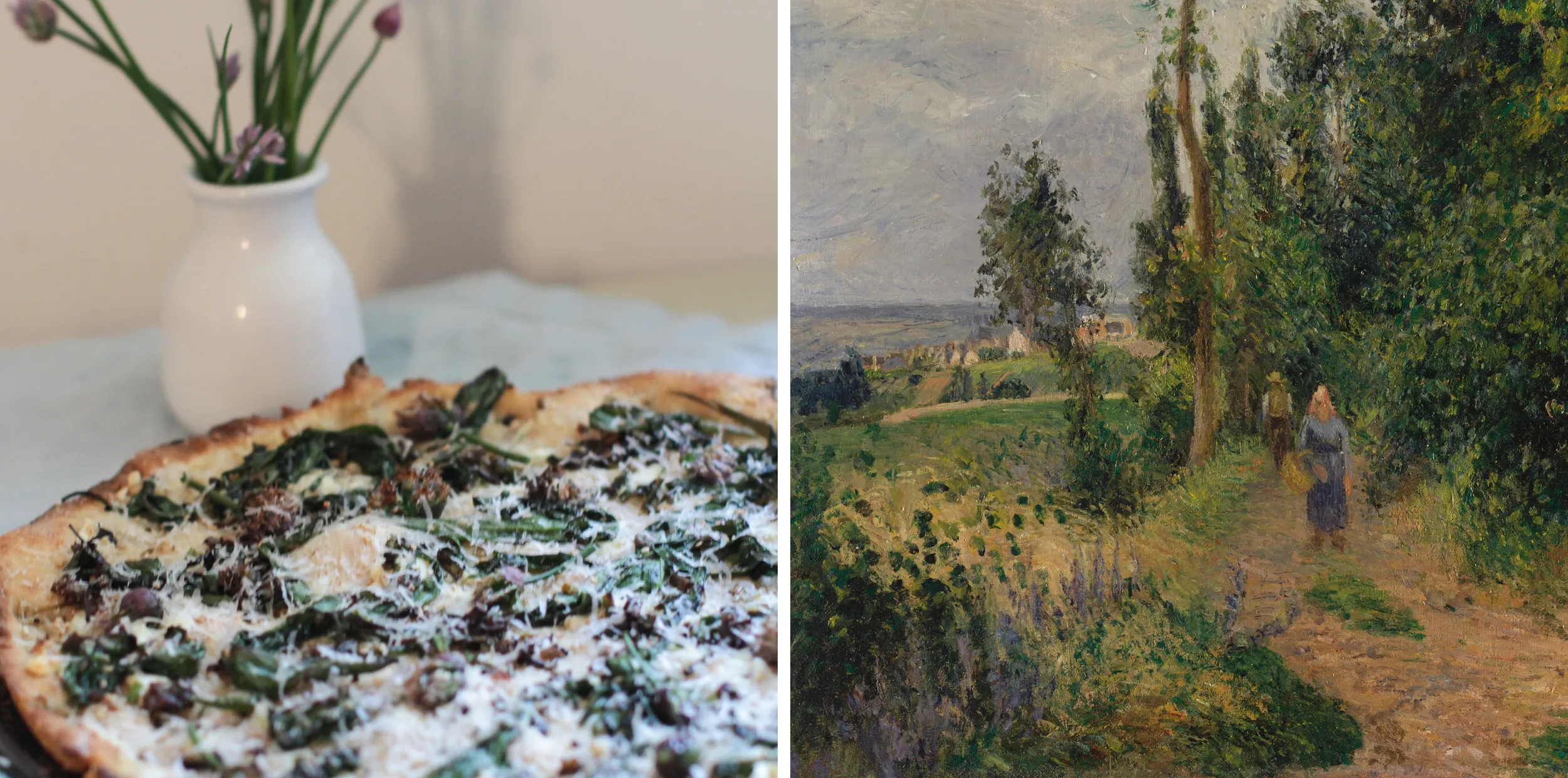
There is scarcely a more beautiful reminder of spring than to see your local farmer’s market awash with harvests of earthy greens topped in colorful bloom. Look around and you’ll see bright yellow kale shoots and squash flowers, white-petalled chamomile flowers, marigold calendula, crimson hibiscus, and the beautiful impetus of this post: purple chive blossoms. Chive blossoms are lavender in hue and delicate like the red clover blossoms used in this recipe for Pommes Normandes. The blooms top off identical vertical green stalks with bursts of individual personality. Each bud pulls the stalk down slightly into a beautiful idyllic drape, willing the otherwise obedient, soldierly chive into a moment of freedom, sway and youth. Often dismissed in the wild as a bloom belonging merely to a member of the onion family as if such a taxonomy were a curse, it is in fact one of the loveliest blooms and better categorized among lilacs and lavender. Whether coated in olive oil and crisped whole or torn into petals and sprinkled as a colorful raw topping, chive blossoms add a lovely wildflower touch to any spring dish.
Wildflowers are nature’s way of draping us and the landscape we occupy in a caress. They prod us to smell, to wander and be curious. They remind us that there is always newness in store on the horizon. I spent many a day of my childhood wandering among fields and roadsides picking wildflowers to make bouquets for my mother. For anyone who remembers what it’s like to make something beautiful out of whatever is around you, they are a reminder that although much aged, changed and more complex, you are also still that same small child, full of wonder, innocence and creativity. Accrued experiences do not nullify simplicity. Just as the myriad species of plants that form an ecosystem, part of which sustains us through beautiful food, we are an amalgam of experience and must remember that part of our composition is as sprightly, simple and beautiful as a spring blossom.
Inspired by the sight of chive blossoms at the market and aware that I was in the midst of the very short ramp season, I decided to hunt down some ramps to pair with these chive blossoms and make a kind of “onions of spring” pizza from my bounty. Some say ramps are overhyped. I disagree. Ramp season is a short season (about two weeks) in which we can all sample and celebrate a unique taste. Garlicky but sweet, flavorful with a bite, ramps are like all the best parts of shallot, garlic, chard, and kale put together and made into something delicate and new. They are worth a trip to the farmer’s market, and if, in my case, you find the ramp basket empty (New Yorkers know their foods), it’s worth approaching the farmer and asking him or her to find some hidden store. To my great joy, I was given a handful, which was all I needed for a beautiful pizza.
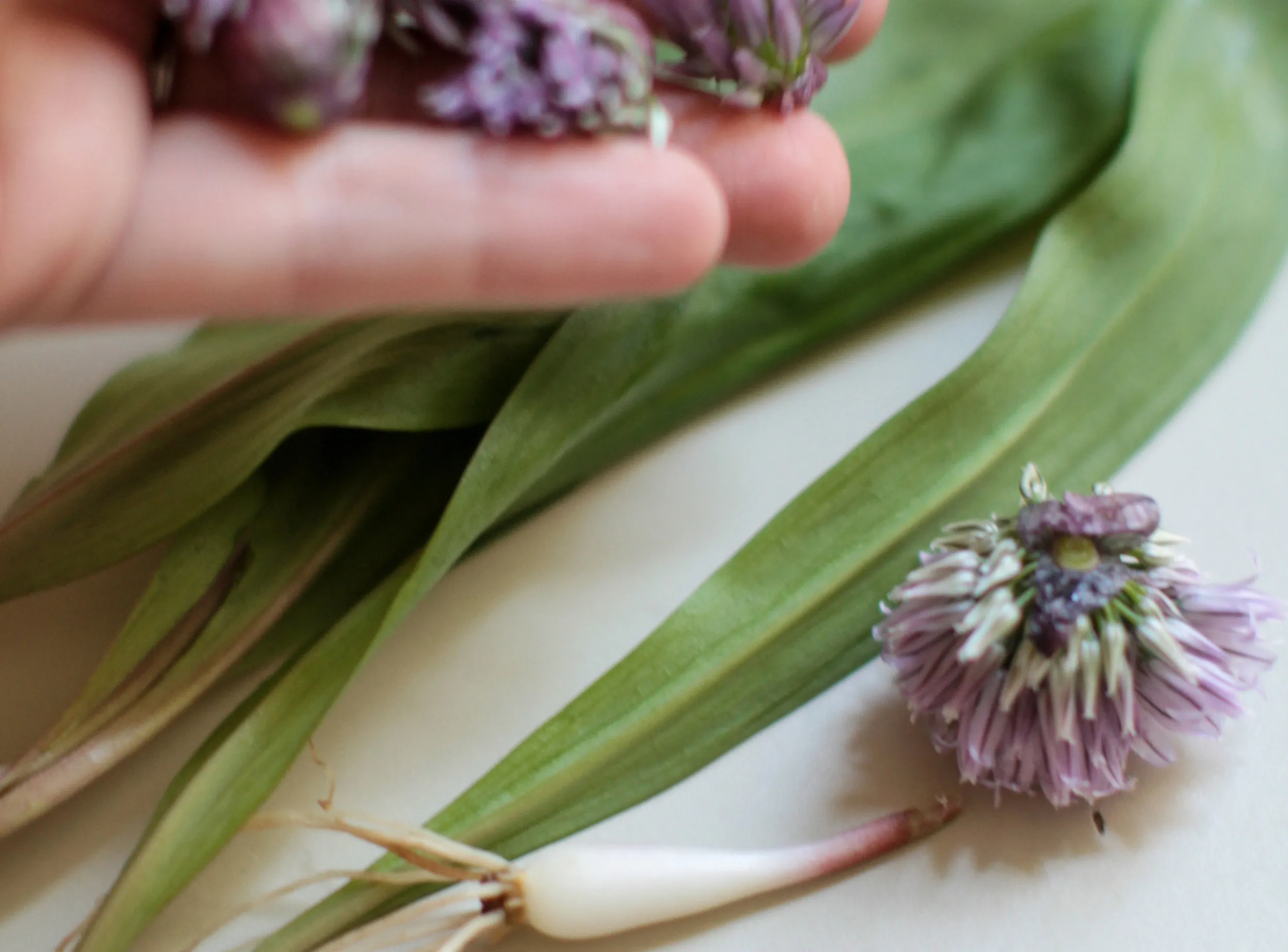
Here’s the thing: cooked well, ramps are one of the loveliest tastes in the world. When ramps fail to delight, it is because they are either 1) too chewy (from not cooking the stalks and bulbs separately or putting fresh leaves on a pizza that doesn’t have an oven hot enough to cook them in time), 2) paired with something distracting (in my opinion the acidity of tomato sauce does it no favors), 3) overused. Give it a light touch, separate the stems (and even the bottom third to half of the middle part of the leaf), sauté the stems/centers/bulbs, wilt the greens just slightly before placing on pizza, and you will adore the taste of what you’ve made.
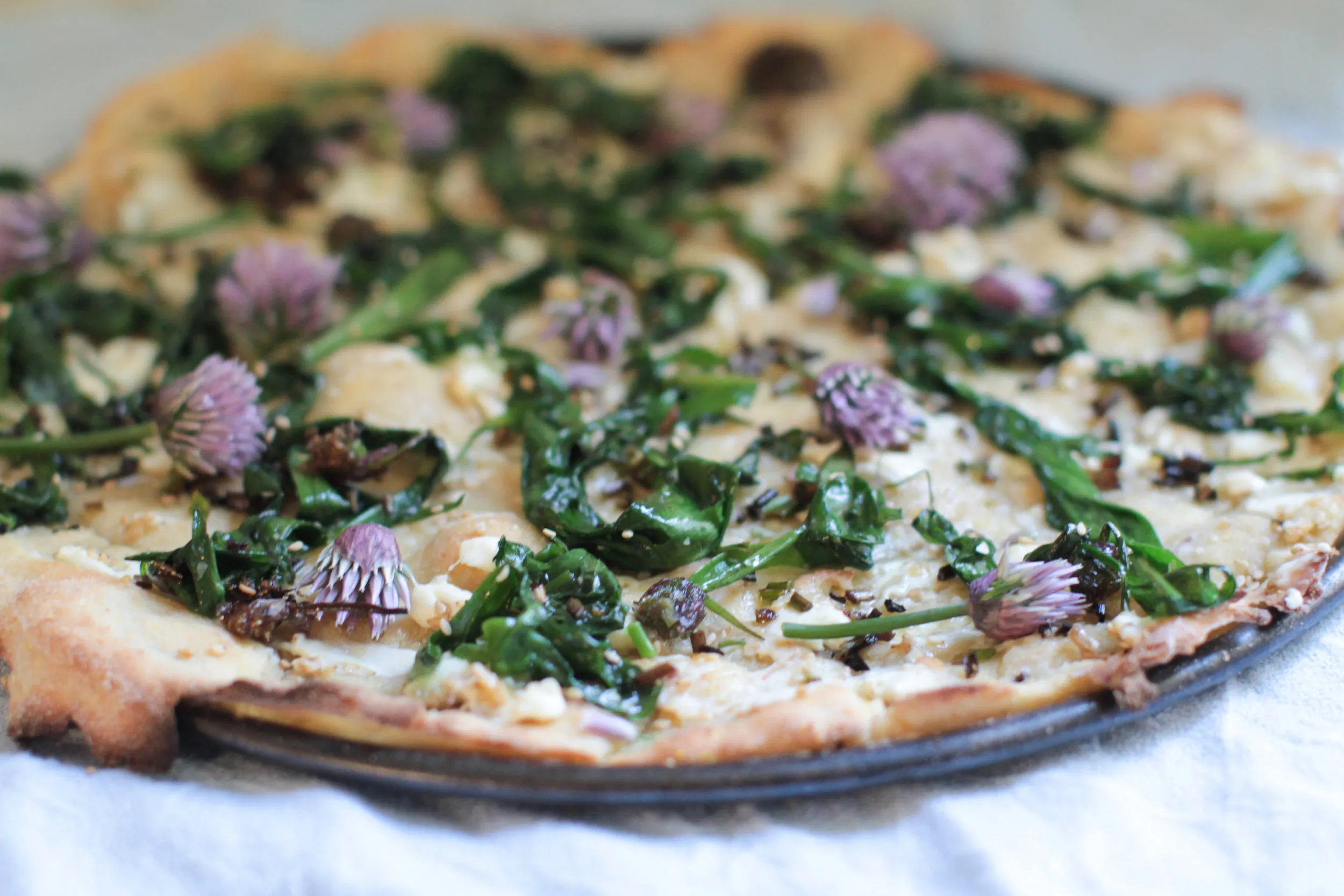
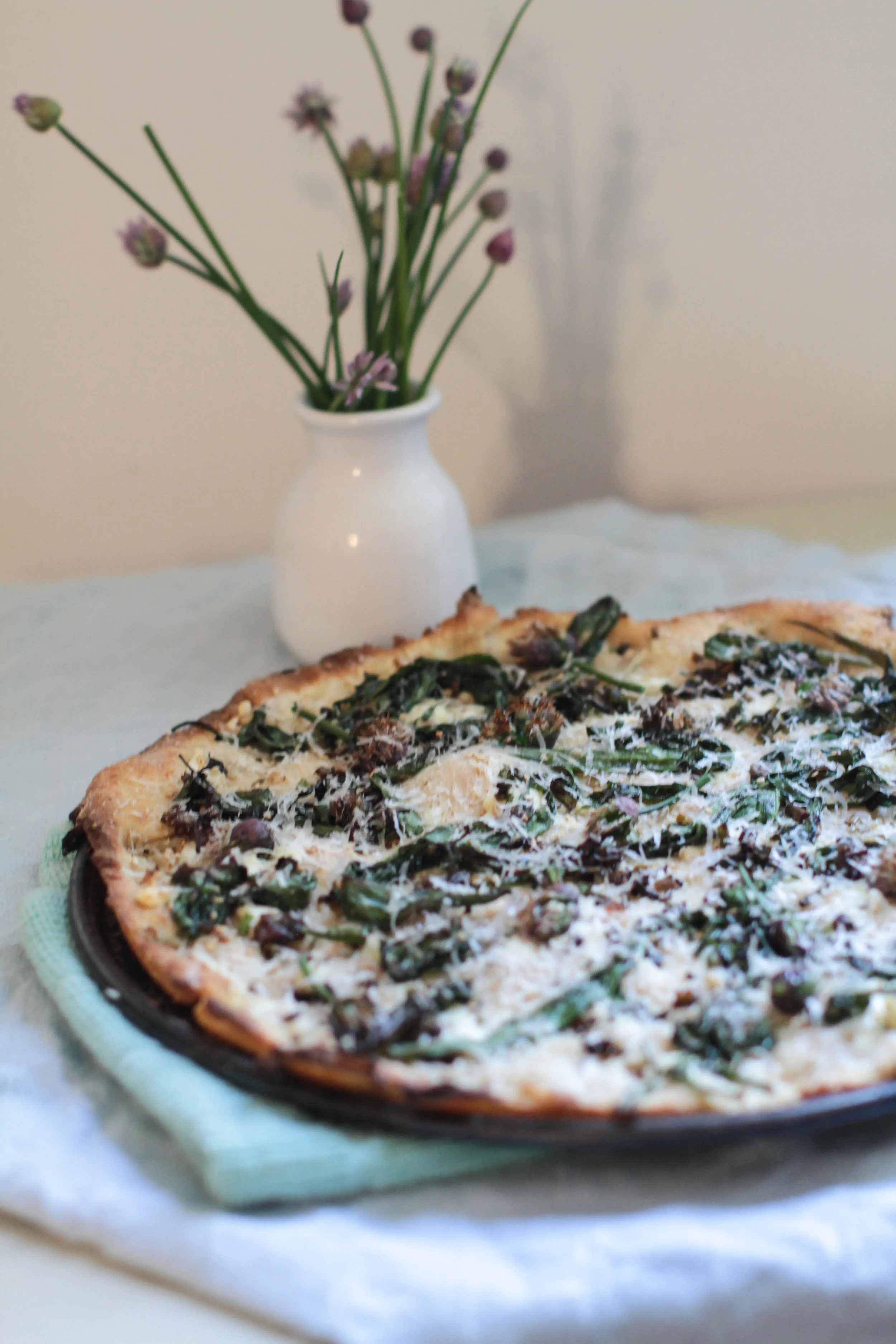
Below is the recipe for a ramp and chive blossom pizza I made on the fly using a gluten-free crust brushed in olive oil and cooked by itself before adding toppings (this is hugely important if you don’t want a gooey, overly dense, undercooked crust), sesame seeds, a very scant creamy cheesy base (use any creamy cheese you have on hand but use no more than 2 oz.—ricotta, goat cheese, even cream cheese in a pinch), kosher salt, ramps, a combination of sautéed and raw chive blossoms (before placing the pizza in the oven), even more olive oil, and a light dusting of parmigianno regianno after emerging from the oven. I truly believe you could omit all dairy if you wish and still have a delicious pizza on your hands.
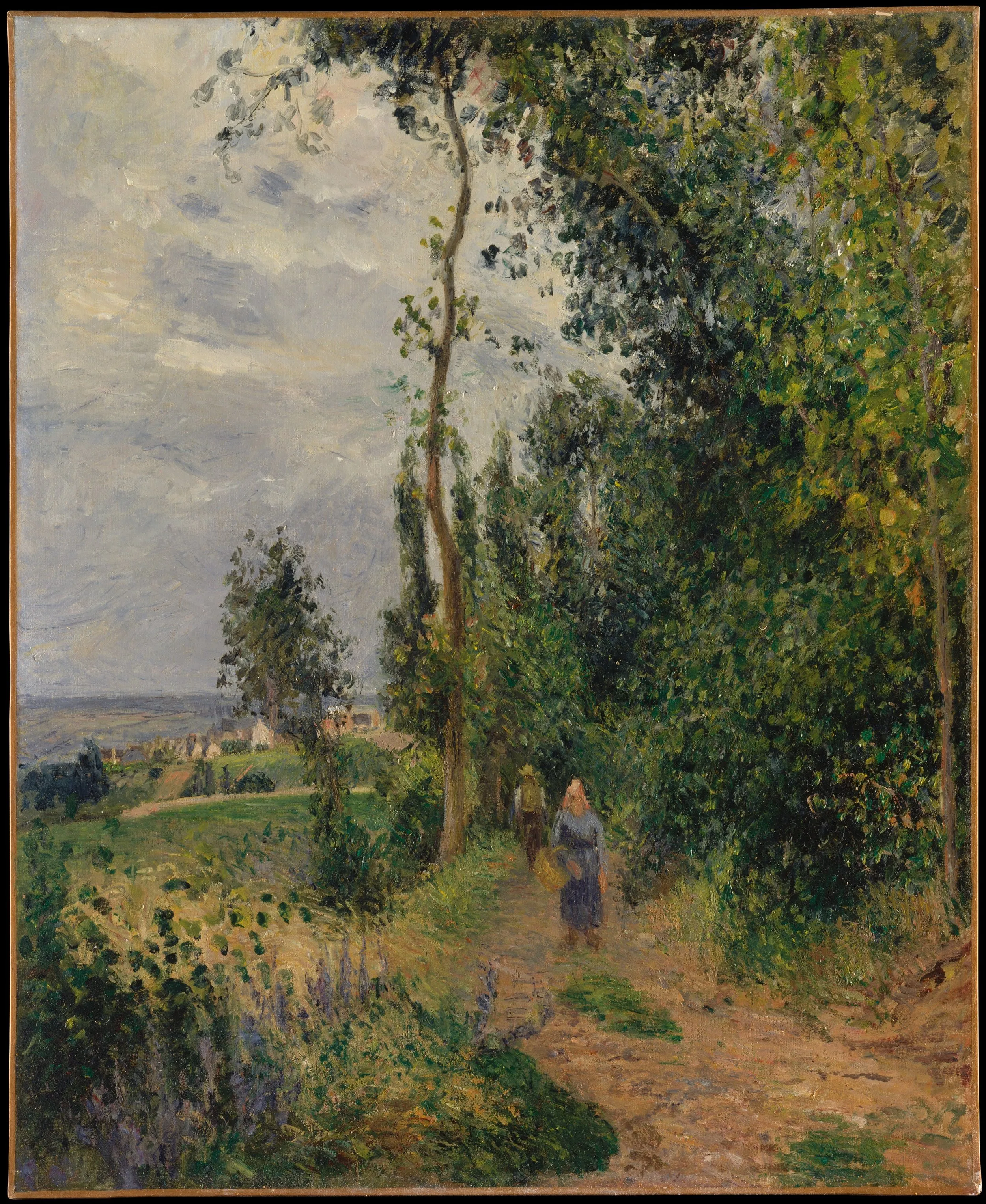
I’ve paired this pizza with a lovely painting of the Pontoise region of France by Camille Pissarro for its touch of purple blooms in the lower left. The pointillist style reminds me of sprinkling a pizza with a dusting of seeds, salts, ramp bulbs and chive stalks. The colors embody that juxtaposition of deep dark green, soft sky and lively spring blooms, and the composition—like many of his paintings—honor the farmers of the region, something I believe we all should do more of. Bon appétit!
Ingredients
- gluten-free pizza dough (I use Wholly brand readymade)
- a cup of corn meal and half a cup of rice flour at the ready (for working with crust) sesame seeds (as many as you wish)
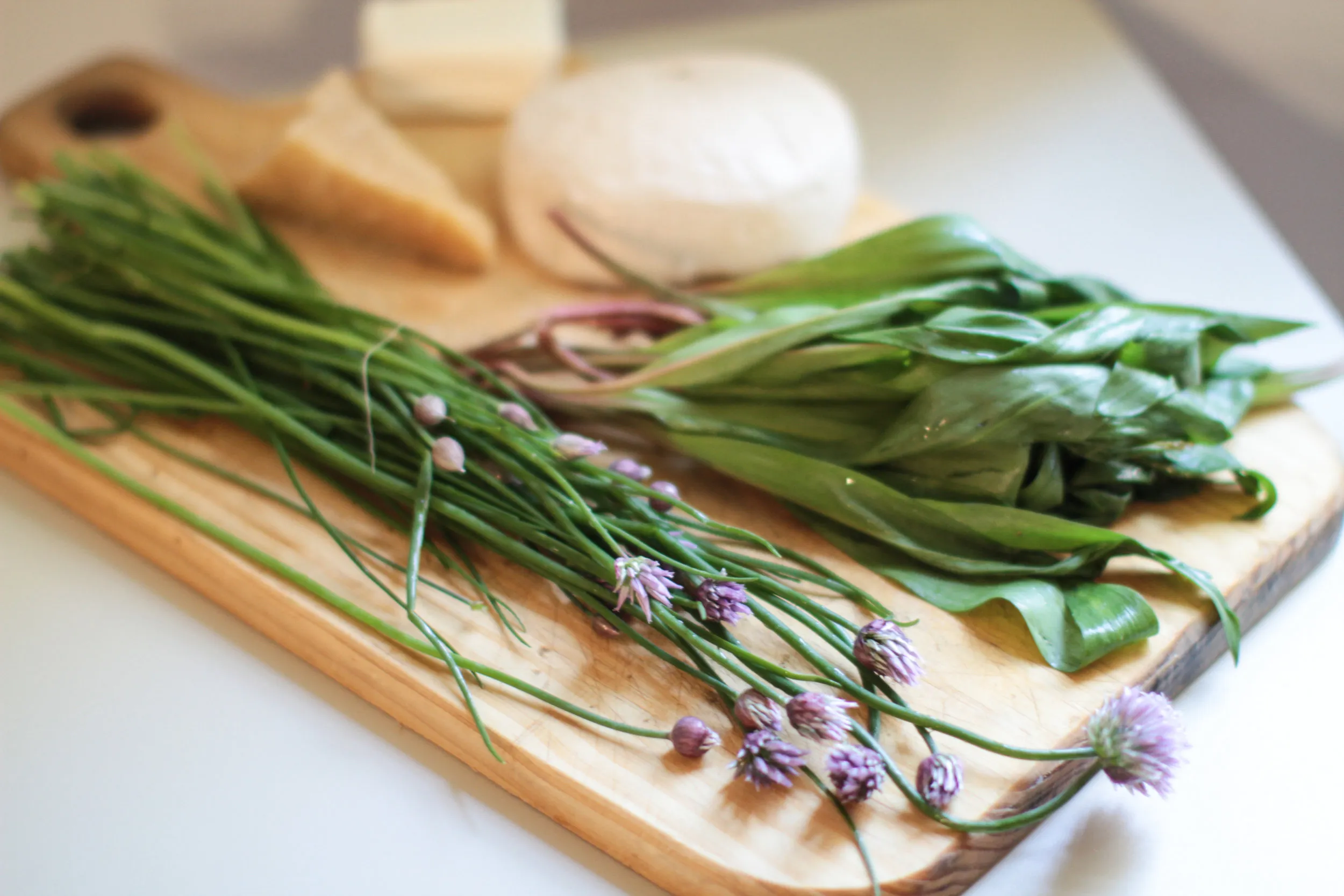
- a handful of ramps (ideally with some bulbs included, but you can go without the bulbs as well)
- a handful of chive blossoms (keep ~2 tbsp of the stalks)
- 2 oz of a creamy cheese (ricotta, goat, neufchâtel, whatever you have)
- a cup of olive oil at the ready (some for brushing, some for sautéeing, some for drizzling)
- kosher salt
- Parmigiano Reggiano, to taste
- 1 tsp lemon zest, if desired
- Preheat oven to as hot as it will go. (500 degrees minimum is ideal)
- Separate bulbs, stems, and inner portion of bottom half of ramp leaves from the remainder of the leaves. Finely chop the non-leaf portions, and slice the leaves in half longways to make them into thinner long strips.
- Finely chop your chive stalks and set your chive blossoms aside.
- Spray a perforated pizza pan with olive oil or canola spray, then sprinkle with corn meal to coat.
- Sprinkle your work surface with a generous helping of rice flour and corn meal (the juxtaposition of the two seems to help prevent sticking, but you could use just one).
- Roll out the dough lightly; a rough shape is preferred. Sprinkle more and more corn meal and rice flour as needed to prevent sticking. Use a spatula to help you lift the rolled dough off the counter and onto your pizza pan. If it breaks, worry not, just reshape onto the pan and piece the portions together. Call it “rustic.” :)
- Brush your crust with a light coating of olive oil and sprinkle with sesame seeds if desired and a touch of kosher salt.
- Place in preheated oven for 5-7 minutes. Set that timer and keep an eye on it—these are very hot temps! If at 5 min it looks like it’s about to burn, take it out, but you should be fine with 7 minutes.
- In a sauté pan, heat some olive oil to medium high heat, add your chopped ramp and chive parts (sans leaves), and most of the chive blossoms. Stir occasionally, cooking for about 4 minutes until lightly browned, tender and aromatic. The blossoms should look like they hav ea touch of crunch, but not be burned. Set aside.
- Add the ramp leaves to the hot pan and barely cook until just wilted. Set aside.
- Take your cheese base and dab it scantily on the pizza crust. Mix with olive oil in a small bowl first if you’d like to be able to brush on the cheese with a pastry brush.
- Top the cheese with your ramp and chive stalks and stems, then arrange the ramp leaves and chive blossoms scantily around the pizza. Add your remaining uncooked chive blossoms.
- Drizzle olive oil lightly along the whole pizza, aiming especially for the uncooked chive blossoms.
- Sprinkle with kosher salt and cook for 7 minutes in the very hot oven.
- Take out and use a fine grater (or zester) to dust the pizza with a touch of Parmigiano Reggiano. A touch of lemon zest could be delicious as well. If desired, add some sprinkles of fresh chive blossoms torn into petals for color.
- Cut using shears or a pizza cutter and serve!