Cy Twombly (born 1958, Virginia, USA) developed a unique personal aesthetic out of the tail end of Abstract Expressionism. He turned away from bold, confident assertions on the canvas and instead introduced an atmospheric, uncertain and inquisitive searching. Twombly studied with Motherwell in his early days and was influenced by him before adapting his work to introduce more physical constraints and compromised execution, such as blindfolding himself or painting with his less dominant hand. I admire the feminine in his work—an air of reception and openness as opposed to a composition drive by male-centric edicts, enclosure and finality. His works are often characterized by their aesthetic of playfulness or childlikeness, but I consider their most compelling quality to be a novel and somewhat cinematic exploration of space and time on the canvas.
Evocative hints of narrative abound on his canvases, often actual words from poetry dispersed, layered, and covered over. The more implicit evidence of the anecdotal lies in the spatial interplay between the atmosphere(s) and elements of each work. His work is a painterly writing, with all the insight, exploration and multiplicity of understandings and viewpoints that writing helps to bring about. The eye travels in unpredictable, frenetic but contemplative movements from moment to moment, much as it does when dreaming. It seems that many themes, aspects and dimensions are packed together as if placed inside a large translucent cube, then peered into and painted onto a flat surface. I find this comparable to how the brain layers and conjoins the varying experiences of our psyche into the broken narratives of dreams of which we peer at one vaguely identifiable scene after another in what nonetheless feels like a single instant.
His works are like a murky, imaginative, perceptive, and historically-conscious film, the elements and progressions of which exist all within either a single canvas, or within the series of canvases he often painted in sets. They are meditative, cumulative, and unfinished—a state more true to human experience than the endings and states of completion we tend to ascribe to our lives. In his open-ended paintings everything goes on in a perpetual state of becoming—whether something lingers as an accrual to be grappled with, jumps over to life in a new form, or disappears into dust, everything is lovingly layered in a kind of complicity that wishes only to see us carry on with both the curiosity of children and the wisdom of a sage.
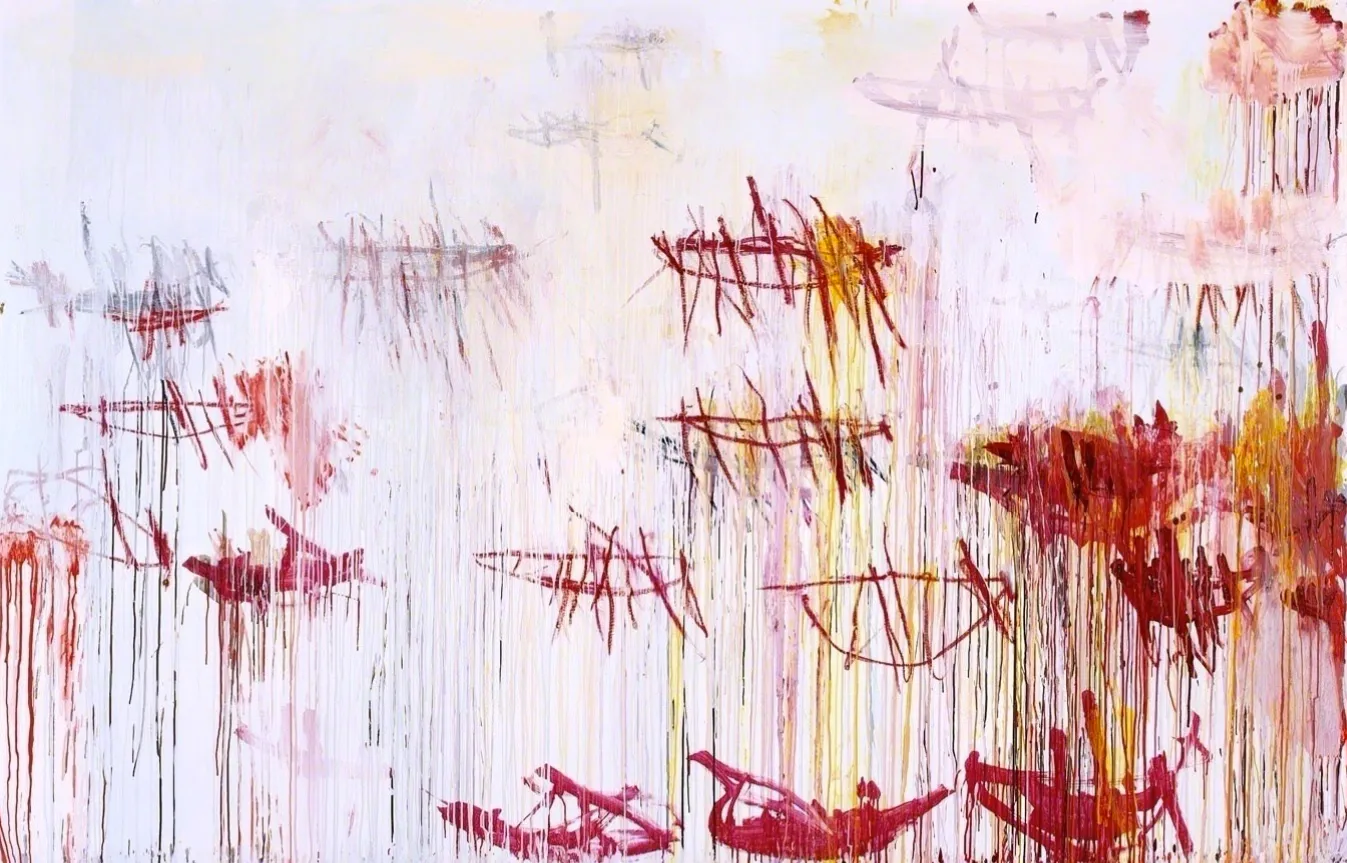
Lepanto is one of Twombly’s series created and exhibited as a suite of 12 paintings. It depicts a naval battle that occurred in 1571, in which European forces under Venetian leadership fought against Ottoman invaders. Richard Howard wrote in the exhibition catalogue, “we witness historical evidence through a personal meditation on tragedy. Certainly *Lepanto *is an accounting, but not a final summing up. We are still, with Twombly in the thick of the fight.” The works carry on a tradition of Lepanto as the subject of large narrative cycles of paintings, first painted by artists who themselves were directly affected by the European allied victory over the Turkish fleet: Titian (1488-1576), Tintoretto (1519-1594), Veronese (1528-1588) and Cambiasi (1527-1585). Twombly’s love of Roman culture—for which he moved to Italy to spend his life—included admiration for historical narratives and the wonder of antiquity. Many works were titled after Classical themes: The School of Athens after Raphael’s fresco, and The Age of Alexander, the conqueror’s name shared with Twombly’s son.
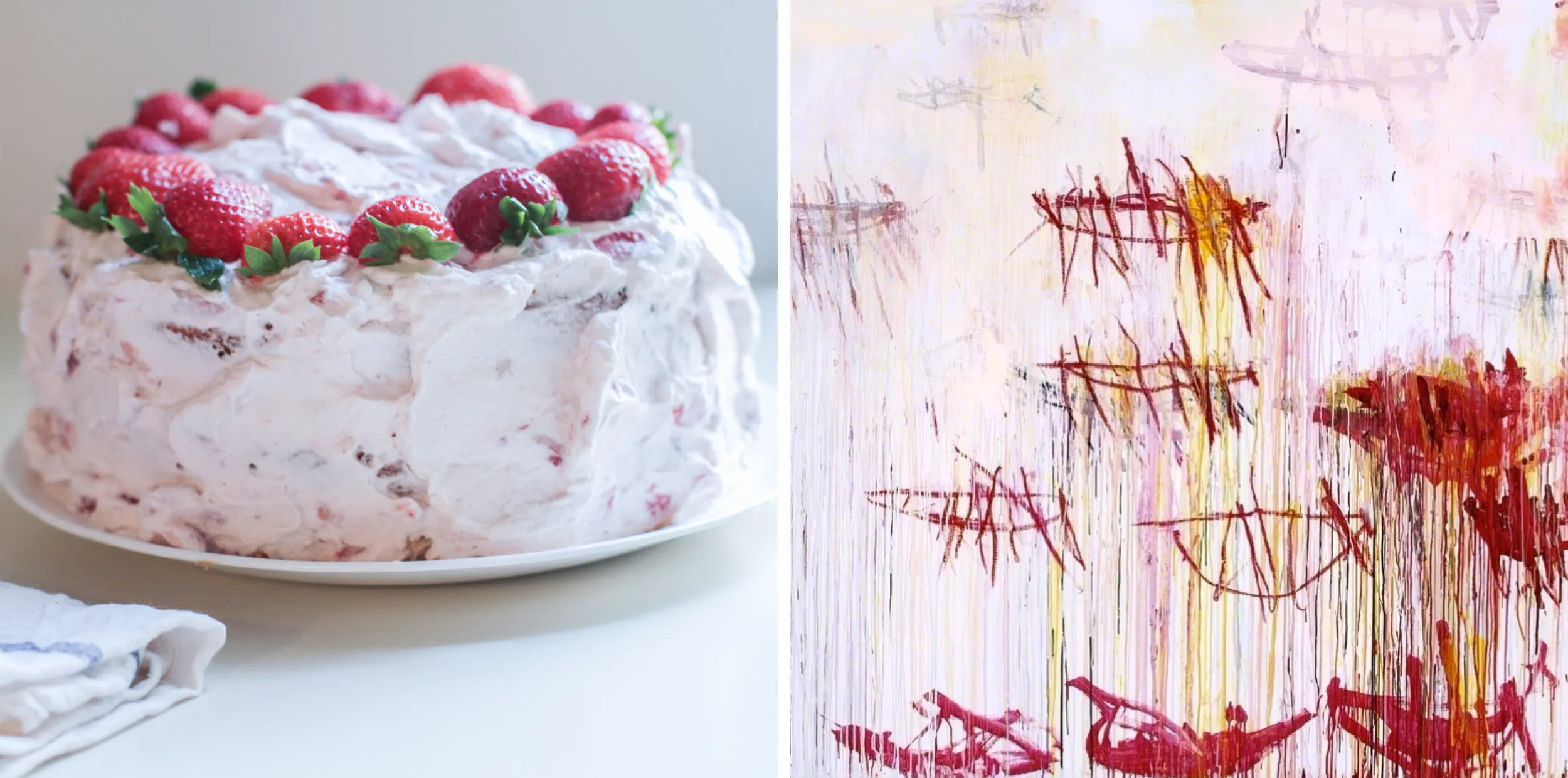
Many of Twombly’s paintings seem luscious in their tactility in a semi-Thiebaudian way. While there is much more at play than simply the material manipulation of a surface—the rich layers, some canvases smeared with thick paint straight from the tube, other areas layered with thin washes—many of his canvases seem to me like they’re made of frosting. For this reason I have paired this artwork with an airy, textural, dreamy strawberry cake I discovered in the search for a perfect birthday cake recipe for a friend. The frosting is a dream—instead of butter it’s made with cream and cream cheese, which lets the flavor of the strawberries shine and gives it a whipped quality that complements the vanilla layers without weighing them down. Sweet but not intoxicatingly so, playful in a way that reminds you of your inner child, uplifting and vivid, genuine with her own inimitable flavor of cool—I chose this recipe for my friend Bari who is all these things and more. Happy birthday, Bari. 🎂 🍰
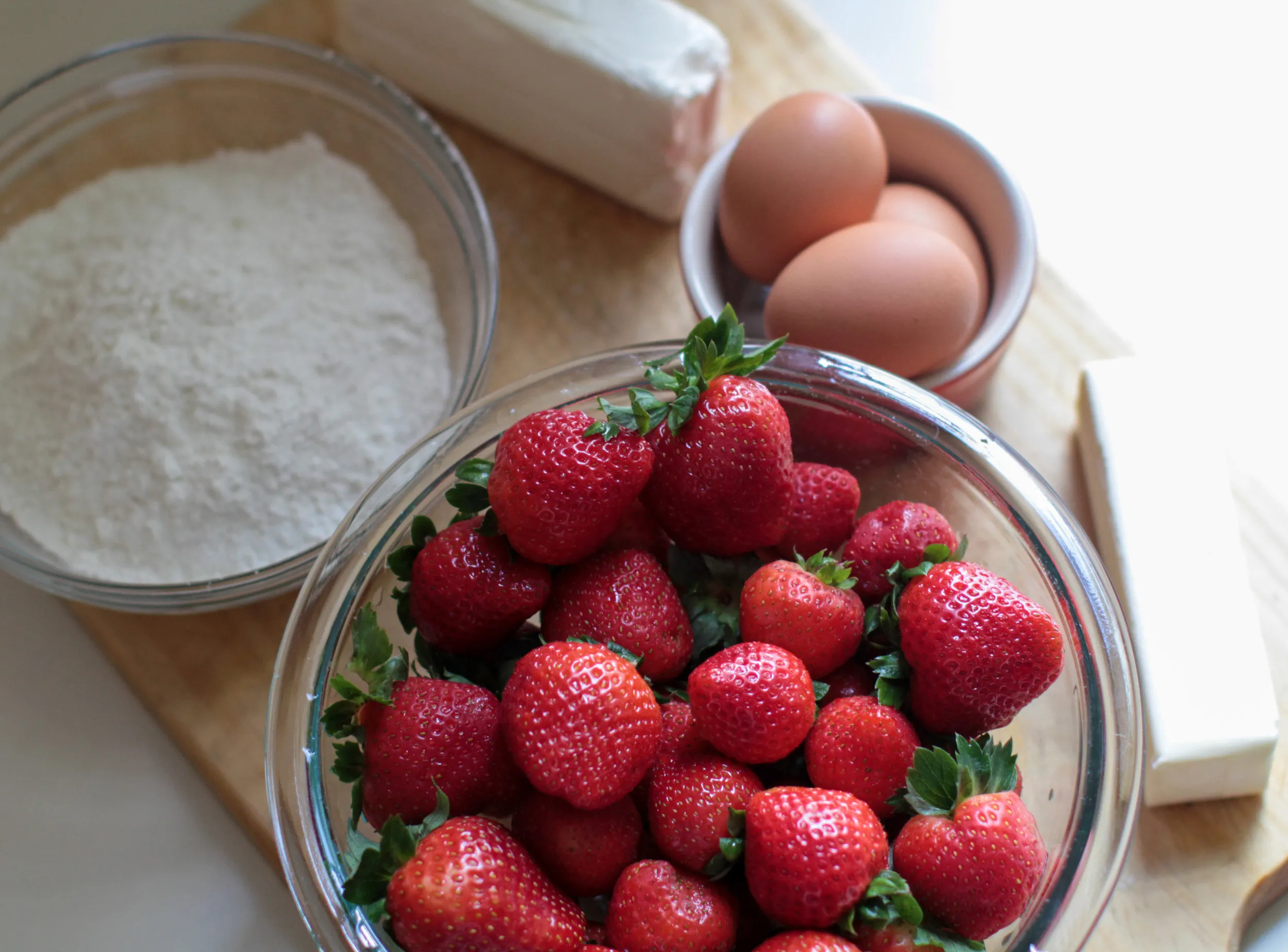
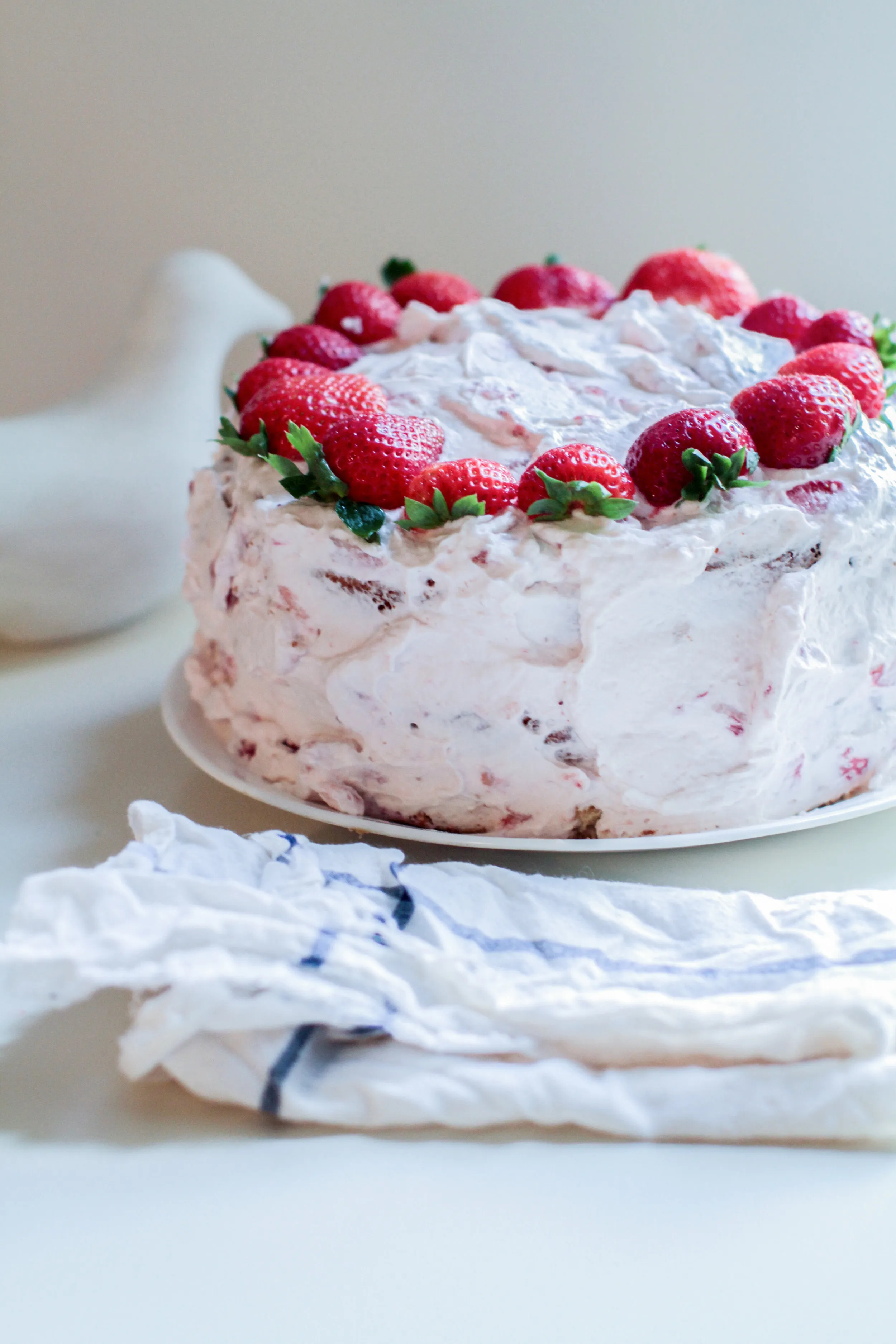
The cake recipe comes from Cooking Classy; the only addition here is sour cherry preserves syrup.
Ingredients
for the cake:
- 3 cups flour
- 1 tbsp baking powder
- 1/2 tsp salt
- 1 cup (8 oz) unsalted butter, softened
- 1 3/4 cup (390g) granulated sugar
- 3 large eggs
- 2 large egg yolks
- 1 1/4 cups (whole or 2%)
- 2 tsp vanilla extract
for the whipped frosting:
- 3 cups heavy cream
- 1 cup (125g) powdered sugar, divided
- 8 oz cream cheese, left at room temperature until partially softened (about 20 - 30 minutes)
- 1/2 tsp vanilla extract
- 1 1/2 lbs strawberries , hulled and sliced into pieces slightly under 1/2-inch
- syrup from sour cherry preserves (“vissino” in Greek, the Italian version sold as *Amarena *cherries—optional)
- sliced strawberries for decorating (optional)
Instructions
- Preheat oven to 350 degrees. Butter 3 9-inch round cake pans then line bottom with a round of parchment, butter parchment and lightly dust pan with flour, shake out excess. Set pans aside.
- Sift cake flour into a medium mixing bowl. Add baking powder and salt and whisk 20 seconds, set aside.
- In the bowl of an electric stand mixer fitted with the paddle attachment (if you don’t have a paddle that constantly scrapes bowl while mixing then stop mixer occasionally throughout entire mixing process and scrape down sides and bottom of bowl to ensure even mixing), whip together butter and sugar until pale and fluffy. Mix in eggs and egg yolks one a time adding in vanilla with last egg yolk. Add 1/3 of the flour mixture at a time (to the butter/egg mixture) alternating with 1/2 of the milk and mixing on low speed just until combined after each addition. Scrape down sides and bottom of bowl and gently fold batter several times.
- Divide batter among prepared baking pans. Bake in preheated oven 25 - 30 minutes until toothpick inserted into center of cake comes out clean. Cool in pan about 5 minutes, run knife around edges of cake to ensure they are loosened then invert onto wire racks to cool completely (the author recommends transferring them to gallon size resealable bags after about 25 minutes of cooling so they don’t dry and let them finish cooling in the bag).
- Once cool frost with Strawberry Cream Cheese Whipped Cream. Store cake in an airtight container in refrigerator.
- For the topping: In the bowl of an electric stand mixer fitted with the whisk attachment, whip heavy cream until soft peaks form (occasionally scrap down sides and bottom of bowl to ensure even mixing), add 1/3 cup powdered sugar and whip until stiff peaks form (make sure they are stiff or your topping will be runny, it should get to the point where it doesn’t have a wet sheen). Scrape cream out into a separate bowl.
- Add cream cheese to bowl of stand mixer, fit with paddle attachment and whip cream cheese until smooth and fluffy, mix in remaining 2/3 cup powdered sugar and vanilla (add the sour cherry syrup here if using, it will make it more pink without needing to use artificial coloring.) Add strawberries and mix gently until uniform in color. Remove bowl from stand mixer, add whipped cream and fold into mixture. Frost over cooled cake, leaving it textured if you wish or using a bread knife to level it out, then top with strawberries if desired.